For the past week I’ve teased my next research project – something I call “America’s Secret Gold War.”
Today, it’s available – and you can read the entire thing here.
Coincidentally, Deutsche Bank just put out its own report, echoing many of the same themes I discuss…
Their concept: “The return of history.”
It’s a throwback to an observation from a political scientist named Francis Fukuyama, who dubbed the term “the end of history” to describe the shift to a total US hegemony starting in 1989, hallmarked by widespread global trade, the end of the Soviet Union, the sale of gold by central banks and a focus on holding massive amounts of U.S. dollars.
Fukuyama argued there was no more argument: the US won. It won the Cold War, the economic war and the monetary war. Game over.
But today, just 37 years later, Deutsche Bank observes the opposite trend.
Dollars are dwindling as an international asset. Gold is climbing. There seems to be a multi-polar world emerging – not a hegemony.
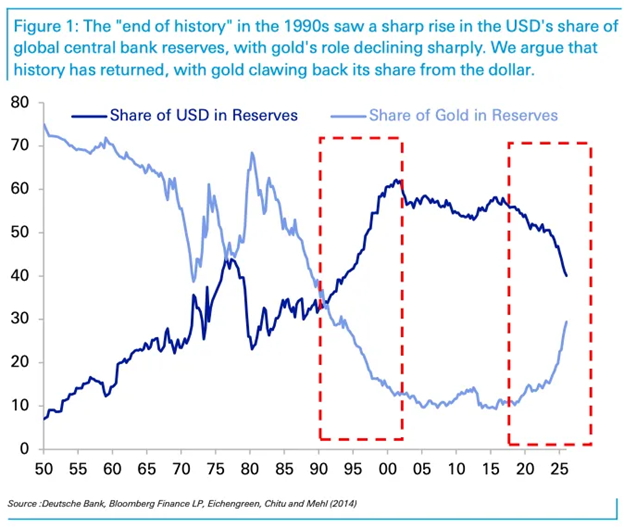
Gold as a share of international reserves is skyrocketing while the dollar is simultaneously plummeting. From the trendlines, it appears they’ll race past each other sometime in the next year, maybe sooner.
Deutsche Bank notes that emerging markets are now the leading purchasers of gold… And that many of these markets are interested in forging their own monetary security through independent gold ownership.
DB believes gold could hit $8k/oz if these emerging markets continue to buy, and gold hits 40% of global reserves.
That 40% number is not far-fetched. The last time gold was at that level was back in about 1989…
Today, gold is about to breach 30% of global monetary reserves.
As I also note in my “America’s Secret Gold War” research, this move is not entirely based on monetary trends. DB agrees. It’s a geopolitical trend. It’s due to power shifting from the West to the East, and the interested parties seeing that the dollar system is in decline.
The ascension of the BRICS, the faltering petrodollar, U.S. tariff policy, diplomatic volatility – these trends are independent of U.S. dollar weakness. They’re geopolitical canaries, all dropping dead simultaneously – all signaling that US hegemony is ending.
Of course, it’s also a monetary story. The U.S. has no way to fund its increasingly large debts without inflation. Trading dollars for gold is a no-brainer.
It’s not all bad news. People have been saying for a long time that America doesn’t need to be the global policeman. It’s expensive and makes America unpopular globally. Trading in the billy club may let America focus on domestic needs…
But in the meantime, whether you call it “America’s Secret Gold War” or you prefer Deutsche Bank’s “return of history” – we’re living through it right now. This situation is rapidly developing and it’s not going to get better by ignoring it.
So here’s what I suggest:
Take a look at my research into this trend.
Pay close attention to how I believe you should proceed to benefit from it – including four different investments that I think you should own today.
It’s not a time to wait and see what happens next. There’s only one path forward for the dollar.
Best,
Garrett Goggin, CFA, CMT
Lead Analyst and Founder, Golden Portfolio